Key takeaways
- Pipe relining is usually worth it when a cracked or root-damaged pipe runs under concrete, tiles, a pool or trees.
- If you're paying to clear the same blockage once or twice a year, relining usually pays for itself in about four to eight years.
- It's not worth it for a collapsed or sagging pipe. Those need digging, at least for the damaged section.
- For a shallow pipe under open lawn, digging can be cheaper. Get both prices.
- The installer matters as much as the method. Ask for footage, a WaterMark product and a written warranty.
On this page
- The real question: worth it compared with what?
- The ten-year cost maths
- 9 honest pros and cons of pipe relining
- When pipe relining is worth it
- When it’s not worth it
- Three common situations, and what makes sense
- What happens if you do nothing?
- How long does a relined pipe last compared with new pipe?
- How to make sure you get a good job
- Relining and selling your home
- What about insurance?
- So, is pipe relining worth it?
Is pipe relining worth it? For most Gold Coast homes with a cracked or root-damaged sewer under concrete, tiles or trees, yes. But not always, and anyone who tells you it’s the right answer for every pipe is selling something.
This guide compares relining with the two other options you actually have, keeping the pipe clear and digging it up. You’ll get rough ten-year cost maths, nine honest pros and cons, and a simple way to decide for your own home.
The real question: worth it compared with what?
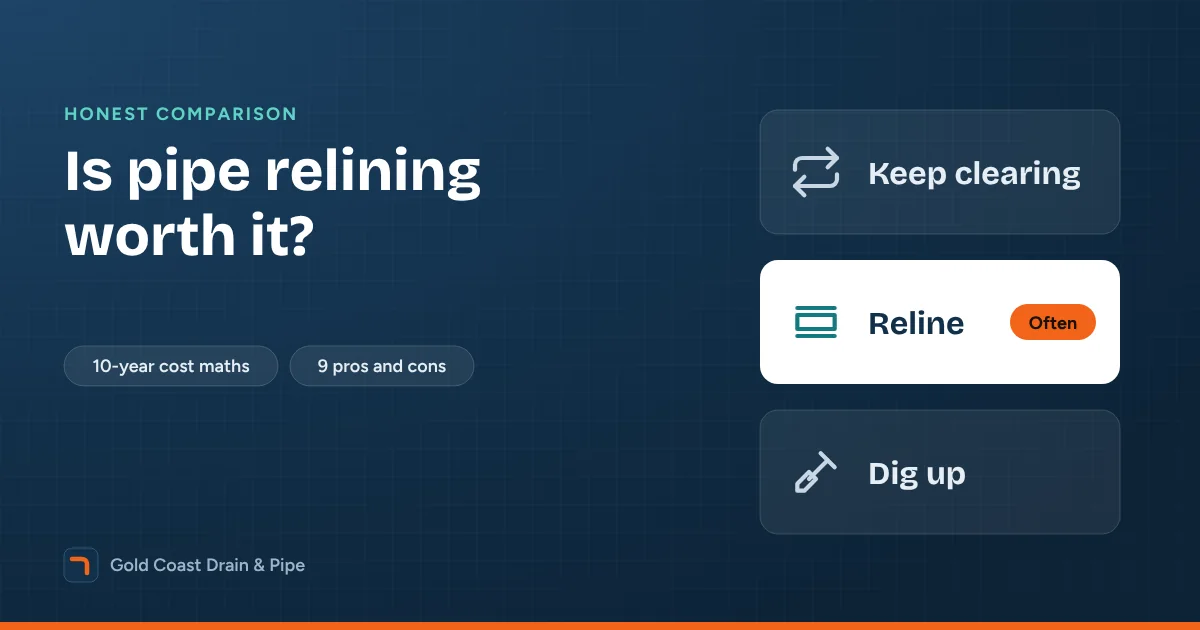
When a plumber finds a damaged pipe, you’re really choosing between three things.
- Keep clearing it. Cut the roots out with a jetter whenever the drain blocks, and live with it.
- Reline it. Install a new liner inside the old pipe, with no digging.
- Dig it up and replace it. Excavate the damaged section and lay new PVC pipe.
Each one can be the right answer. Pipe relining sits in the middle on upfront cost, and usually comes out ahead once you count everything else.
The ten-year cost maths
Let’s take a common example: six metres of old clay sewer pipe with roots at four joints, running under a concrete driveway. These figures are rounded from 2026 Australian price guides from Oneflare and The Quote Yard. They’re estimates for comparison, not quotes.
Option 1: keep clearing. A drain clear with a camera and jetter typically costs $350 to $1,100. Roots usually grow back within six to twelve months. Over ten years that’s ten to twenty visits, or roughly $3,500 to $14,000, and you still have a broken pipe at the end.
Option 2: reline. Six metres at about $2,000 for the first metre and $550 for each one after comes to about $4,750, plus a junction or two and the inspection. Call it $5,000 to $6,000, once.
Option 3: dig up. The pipe work itself might be $200 to $400 per metre, but the driveway has to be cut, removed and re-poured. Concrete reinstatement alone is commonly $100 to $200 per square metre, and the job takes days rather than hours.
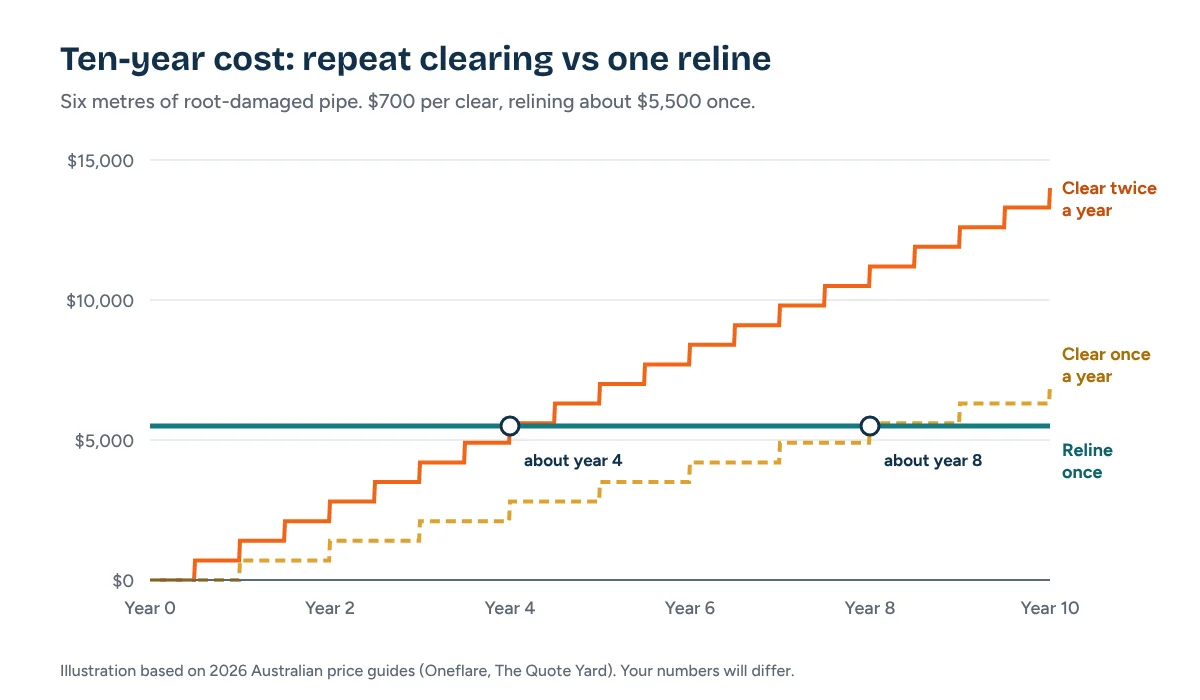
The pattern is clear. Using a middle-of-the-range $700 per clear, a pipe that needs clearing twice a year costs about the same as relining after four years. Once a year, it takes about eight. If the pipe only blocks every few years, clearing it may genuinely be the cheaper path for now.
9 honest pros and cons of pipe relining
The pros
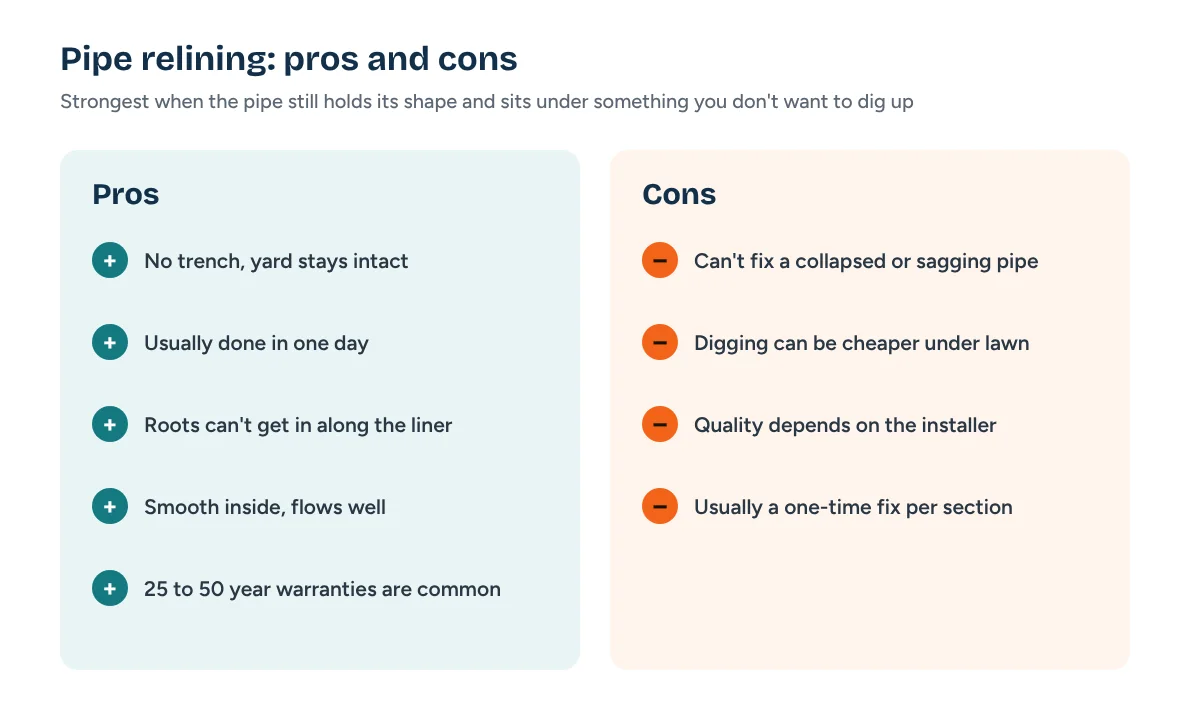
1. No trench. The pipe is fixed through the existing inspection openings. Your driveway, bathroom floor, garden and pool stay where they are.
2. Usually done in a day. Most house jobs are finished by the afternoon, so you’re not without a toilet for days.
3. Roots can’t get back in along the liner. Roots enter through joints and cracks. A continuous liner has no joints along its length, which is why relining ends repeat root blockages rather than just clearing them.
4. Smooth inside. The new surface has no lips or rough spots for waste to catch on. Even though the liner is a few millimetres thick, flow is usually as good or better.
5. Long life. Liner warranties in Australia commonly run from 25 to 50 years, and products are designed to last for decades.
The cons
6. It can’t fix everything. A collapsed pipe has nothing to hold the liner in shape. A sagging pipe that holds water will still hold water after it’s lined. These need digging, at least for the bad section.
7. It isn’t always the cheapest. For a shallow pipe under open lawn with easy access, digging can cost less. You should ask for both prices in that situation.
8. The result depends on the installer. Poor cleaning, the wrong resin or rushed curing can lead to wrinkles or a liner that doesn’t bond. The method is proven. The workmanship varies.
9. It’s generally a one-time fix. Each liner makes the pipe slightly narrower, so relining the same section twice isn’t usually recommended. And a warranty is only as good as the company behind it, so check who you’re dealing with.
When pipe relining is worth it
Relining is usually the right call when most of these are true:
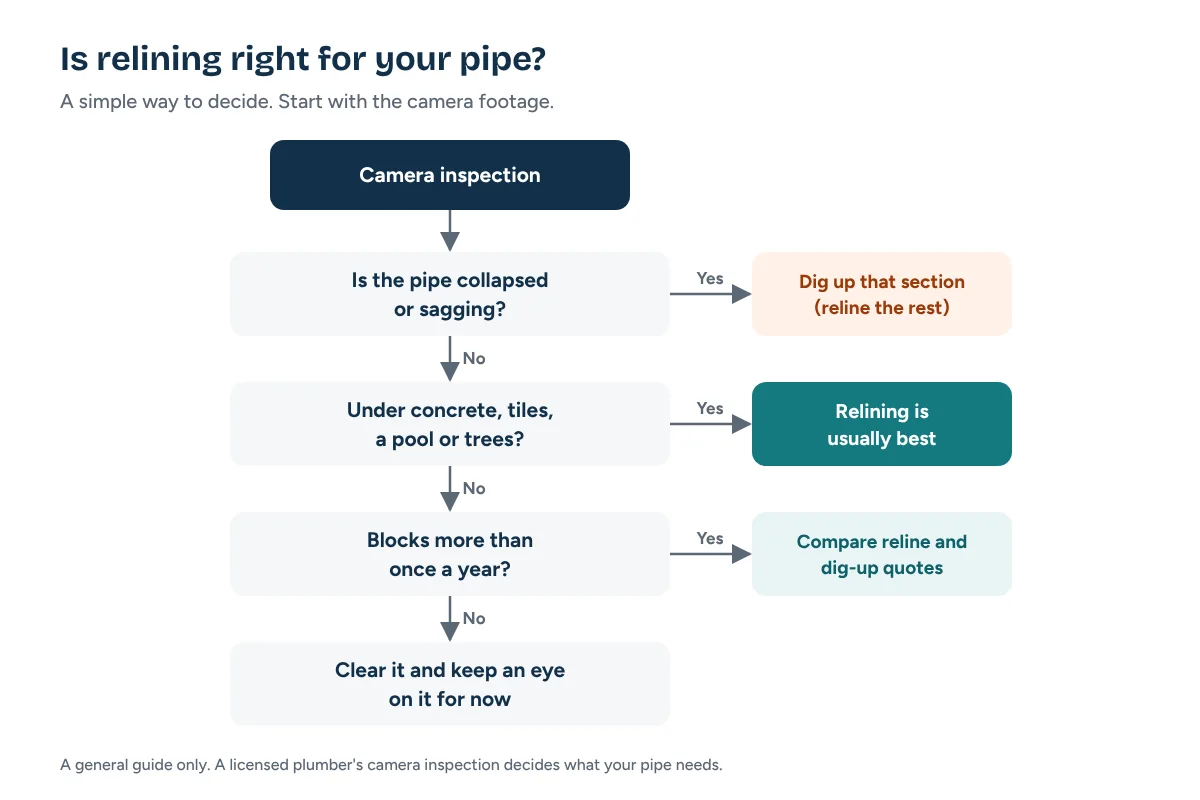
- The camera shows cracks, root intrusion or leaking joints, but the pipe still holds its shape.
- The pipe runs under a driveway, slab, tiled floor, pool, deck or established trees.
- You’ve had the same blockage cleared more than once in the past couple of years.
- The damage is spread over several joints, which is common in clay pipes laid before the late 1980s.
- You plan to stay in the house for a while, or you want the drain issue settled before you sell.
A good example is a 1970s or 1980s house in one of the older coastal suburbs, where the sewer runs under the driveway and a big tree has been sending roots into the joints for years. That’s almost exactly the job relining was designed for.
When it’s not worth it
Save your money, or at least get a second option, in these situations:
- The pipe has collapsed or badly sagged. You’ll need a dig-up for that section. A partial dig plus relining for the rest is common and sensible.
- The pipe is shallow, short and under lawn. Get a dig-up price as well. It may be cheaper and you end up with brand new PVC.
- There’s one small root intrusion and it blocks rarely. A single patch or an occasional clear may be enough for now.
- The problem is in the council’s section of the sewer. On the Gold Coast, the City is responsible for the pipe from the property connection point to the main. The City of Gold Coast sewer blockages page explains the boundary and the reimbursement process.
Three common situations, and what makes sense
These are typical of the calls a Gold Coast plumber gets. Yours won’t match exactly, but one of them is probably close.
An older home with a big tree near the sewer
A 1970s brick house in an established suburb. The toilet backs up every winter, and the plumber jets out a ball of roots each time. The camera shows roots at five joints along eight metres of clay pipe, some of it under the driveway.
What makes sense: full relining of that run. Patching five joints would cost almost as much, and digging means cutting the driveway and working around the tree. This is the job pipe relining was made for, and the repeat call-outs stop.
A newer home in a northern estate
A house built in the 2010s with PVC drains. The kitchen sink blocks now and then, but the toilets and showers are fine. The camera shows a grease build-up in the kitchen line and no cracks or roots.
What makes sense: no relining at all. A jetter clears the grease, and better habits at the sink keep it clear. Nothing is broken, so there’s nothing to reline. A good plumber will tell you that.
A shallow pipe under the back lawn
A low-set house with a short stretch of cracked sewer pipe running under open lawn, less than a metre deep, with nothing built over it.
What makes sense: get both prices. Digging up two or three metres of shallow pipe under grass can cost less than relining, and you end up with brand-new PVC. If the crack sits close to the house slab or a path, relining that section may still be easier.
What happens if you do nothing?
It’s a fair option to consider, especially if money is tight. Here’s what usually happens when a damaged sewer pipe is left alone.
Roots keep growing through the same gaps, and each year the mass gets bigger and blocks faster. Cracks widen, and soil can wash into the pipe through them, which can eventually leave a void under the pipe and let it sag. A sagging or collapsed section can no longer be relined, so the cheaper repair option disappears.
Meanwhile, every blockage risks sewage backing up through the overflow relief gully or, worse, a floor waste inside. That’s unpleasant, and cleaning up after an indoor overflow can cost more than the repair you were putting off.
Doing nothing for a while isn’t a disaster. Doing nothing for years usually turns a relining job into a digging job.
How long does a relined pipe last compared with new pipe?
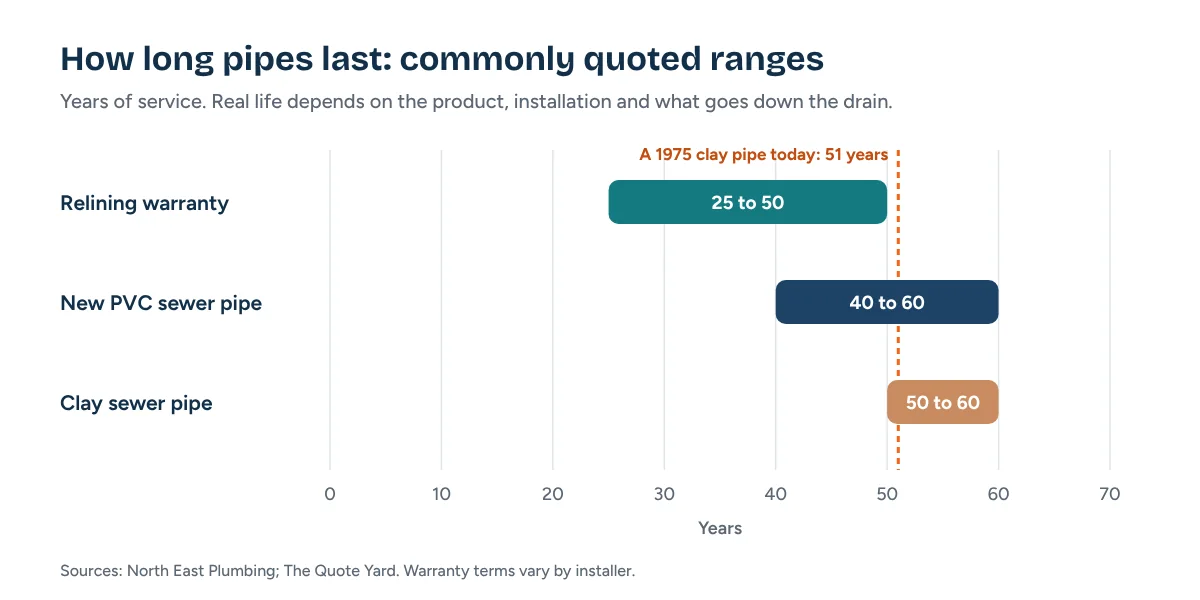
This is the question most people ask, and the honest answer is that relining hasn’t been around long enough in Australian homes to have a full fifty years of real-world data. What we do have is warranties, which commonly run from 25 to 50 years, and manufacturer design lives in the same range.
For comparison, plumbing guides often quote 40 to 60 years for a new PVC sewer pipe. So a good liner and a new pipe sit in a similar range. The difference is that you get there without the trench.
The same guides quote around 50 to 60 years for clay pipe. That matters on the Gold Coast, because a clay sewer laid in the 1970s is now somewhere around that age. If your house is from that era and the drain has started blocking, the pipe may simply be reaching the end of its working life.
A few things make a liner last longer. Thorough cleaning before installation, a WaterMark-certified product, proper curing time, sealed junctions, and not pouring fat or flushing wipes afterwards. Our guide to what pipe relining is explains each step of the job in more detail.
How to make sure you get a good job
Since the installer matters so much, here’s what to ask before you agree to anything.
- Can I see the before footage? You should see the cracks or roots yourself.
- Which liner product do you use, and is it WaterMark certified? You want a clear answer.
- What’s included in the price? Inspection, cleaning, liner, junction reinstatement, final camera check and clean-up.
- What’s the warranty, and is it in writing?
- Will I get the after footage? Keep it with your house documents.
- Is your licence current? Drainage work in Queensland must be done by a licensed plumber or drainer.
For the price side of those conversations, our pipe relining cost guide has three worked examples with realistic numbers.
Relining and selling your home
If you’re planning to sell in the next few years, a damaged sewer is worth thinking about now. A standard building and pest inspection usually doesn’t look inside the drains, but more buyers are now paying for a separate CCTV drain inspection before they commit, especially on older homes with big trees.
If that camera finds roots and cracks, it becomes a bargaining point, and buyers tend to assume the worst-case repair cost. Fixing the pipe before you list, and keeping the after footage and the written warranty with your sale documents, takes that argument off the table.
It won’t add much to the sale price on its own. What it does is remove a reason for a buyer to ask for money off, or to walk away late in the process.
What about insurance?
Many home insurance policies exclude damage that develops slowly, such as tree roots or old pipes wearing out. Some cover sudden damage or the cost of finding the leak. It’s worth reading your policy wording before you book, but don’t assume insurance will pay for a reline.
If you rent, the pipe is the owner’s responsibility. Tell your property manager about repeat blockages in writing so there’s a record.
So, is pipe relining worth it?
If your pipe is cracked or full of roots, still holding its shape, and sitting under something you don’t want to dig up, pipe relining is very likely worth it. You pay once, the yard stays intact, and the repeat blockages stop.
If the pipe has collapsed, sags, or runs under easy-to-dig lawn, get a dig-up price as well and compare honestly. The first step is the same either way: a camera inspection, so you’re deciding based on what’s really in the ground.
Frequently asked questions
Is pipe relining worth the money?
In most cases where the pipe is still holding its shape and runs under something hard to dig up, yes. It avoids rebuilding driveways, floors and gardens, and it stops repeat blockages from roots. For a shallow pipe under lawn, compare it with a dig-up quote.
How long does pipe relining last?
Liner warranties in Australia commonly run from 25 to 50 years. The real life depends on the product, how well the pipe was cleaned before lining and what goes down the drain.
Is relining as strong as a new pipe?
A properly installed liner is a structural pipe in its own right, designed to carry the flow without relying on the old pipe. It isn't a fix for a pipe that has already collapsed, though, because the liner needs the old pipe to hold its shape while it cures.
Can tree roots grow through a relined pipe?
Roots get into pipes through joints and cracks. A continuous liner has no joints, so roots have nothing to grow into along the relined section. Junctions are the weak point, which is why good installers seal them.
Does relining add value when selling a house?
It won't add much to the sale price, but a written warranty and camera footage of a sound sewer line can reassure buyers and stop a drain problem from becoming a sticking point in negotiations.
Is pipe relining worth it for a rental property?
Often, yes. Repeat blockages in a rental mean emergency call-outs, unhappy tenants and possible rent reductions if the toilet is out of action. Fixing a root-damaged sewer once is usually cheaper than paying for the same blockage again and again.
Can every pipe in my house be relined?
Most sewer and stormwater pipes can, as long as they still hold their shape and there's an access point at one end. Pipes that have collapsed, sag badly or are too narrow or tight for the equipment may need a different repair.
About this guide
Written by the Gold Coast Drain & Pipe team and last checked on 29 October 2026. Prices come from current Australian price guides and include GST. Your plumber confirms a firm price before starting any work.
Gold Coast Drain & Pipe is a referral service. We connect you with one licensed, independent Gold Coast plumber and don't carry out plumbing work ourselves. How our service works.
Sources