Key takeaways
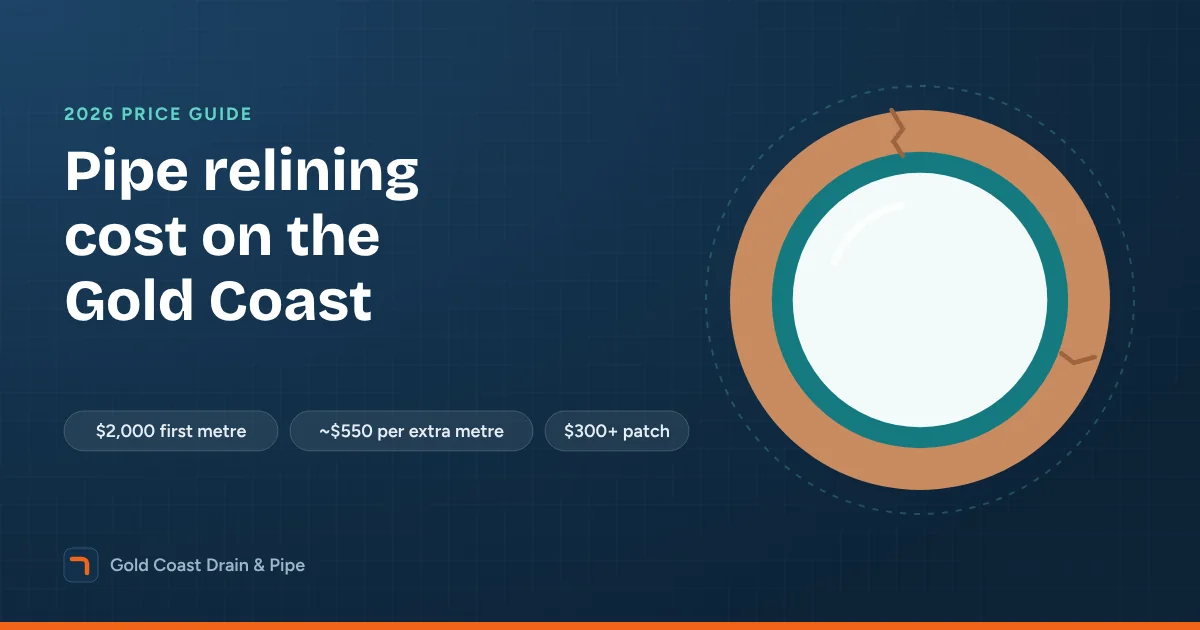
- Most guides put pipe relining cost at about $2,000 for the first metre, then roughly $550 for each extra metre.
- A single patch repair usually costs $300 to $1,000 on its own, but the camera inspection and cleaning are often extra.
- A typical residential job lands somewhere between $4,000 and $10,000, depending on length, junctions and access.
- Digging can be cheaper when the pipe is shallow and under lawn. Relining wins under slabs, driveways, pools and big trees.
- Ask for the CCTV footage, the liner product's WaterMark details and a fixed price before any work starts.
On this page
- Pipe relining cost at a glance
- Why the first metre costs so much
- Patch relining vs full relining: the biggest price difference
- Three worked examples
- What pushes a relining cost up or down
- Pipe relining cost vs digging up the pipe
- Who pays: owner, landlord or council?
- Pipe relining cost for units, townhouses and stormwater
- How to get a fair quote
- Ways to keep the cost down
- Is the relining cost worth it?
If a plumber has just told you the sewer pipe is cracked or full of tree roots, the first question is always the same: what is the pipe relining cost going to be? The honest answer is “it depends”, but that isn’t much use when you’re trying to budget. So this guide gives you real numbers from 2026 Australian price guides, shows how a quote is built, and walks through three worked examples you can compare with your own situation.
We’ll also cover the times relining isn’t the cheapest choice, because sometimes it isn’t.
Pipe relining cost at a glance
Here are the figures most Australian guides agree on. They include GST and assume a normal house on a standard block.
| Job | Usual price | What it covers |
|---|---|---|
| First metre of relining | about $2,000 | Setup, equipment, resin and the first metre of liner |
| Each extra metre | $400 to $800 (average about $550) | Liner and resin for the extra length |
| Single patch repair | $300 to $1,000 | One short liner over one crack or joint |
| Junction reinstatement | $300 to $600 each | Cutting open a branch pipe after the liner goes in |
| CCTV drain inspection | $250 to $450 | Camera survey to find and measure the damage |
| Typical full residential job | $4,000 to $10,000 | Most house sewer lines, start to finish |
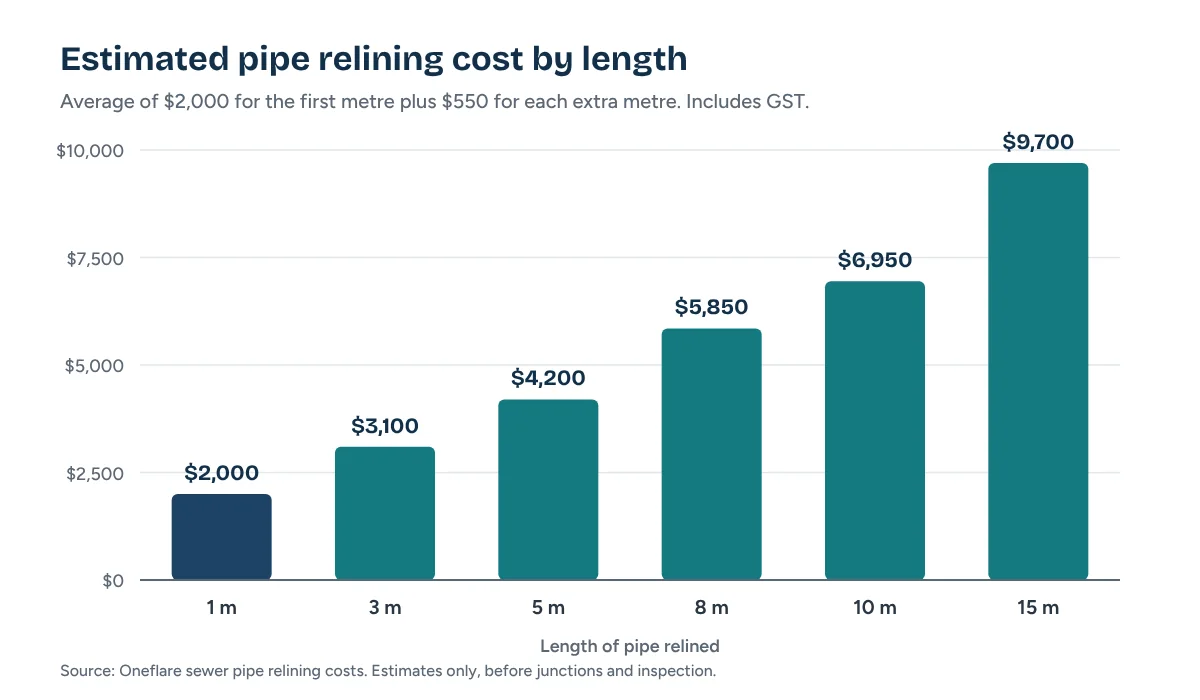
The figures come from Oneflare’s sewer relining cost guide and The Quote Yard’s 2026 relining guide. Gold Coast prices sit inside these ranges. You may pay a little more if the plumber is travelling from Brisbane or the job needs to be done after hours.
Why the first metre costs so much
The first metre carries the whole cost of turning up and setting up. Before any liner goes in, the crew has to:
- Run a camera through the pipe to find every crack, root and joint.
- Clean the pipe back to bare wall, usually with a high-pressure water jetter or a cutting tool for roots.
- Measure the length and diameter, then cut and wet out the liner with resin on site.
- Install and cure the liner, which can take a few hours depending on the resin and curing method.
- Run the camera again to check the finished job.
Most of that work is the same whether you reline one metre or ten. That’s why the price per metre drops as the job gets longer. A 10-metre reline doesn’t cost ten times as much as a one-metre reline. It costs closer to three and a half times as much.
Patch relining vs full relining: the biggest price difference
There are two very different jobs hiding under the word “relining”, and they explain most of the price gap between quotes.
Patch relining fixes one short section, usually a single cracked joint or one spot where roots got in. The liner is often under a metre long. It’s the cheapest option when the rest of the pipe is in good condition.
Full relining puts a continuous liner through the whole run, from one access point to another. It’s the right call when the camera shows damage at several joints, which is common in older clay pipes where every joint is a weak point.
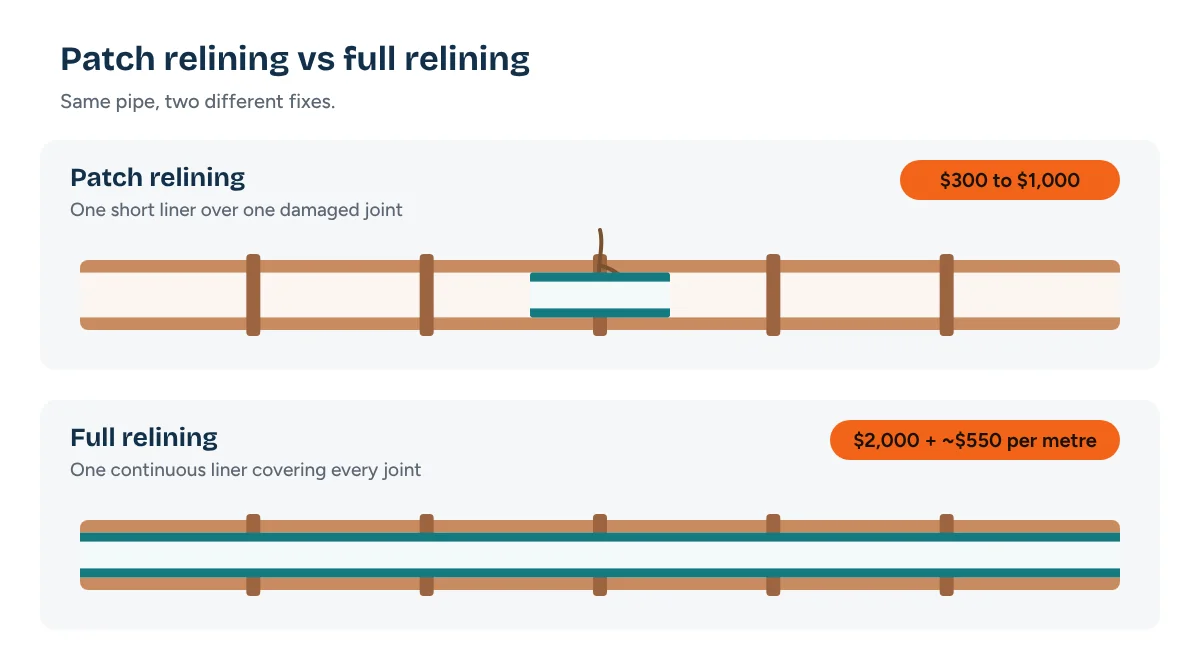
Here’s the catch that confuses a lot of people. Price guides list a patch at $300 to $1,000, but some quotes for “a patch” come in at $1,500 to $3,000. Both can be fair. The lower figure is usually the patch alone. The higher one usually includes the camera inspection, the jetting and the follow-up check. Always ask what’s in the number.
If your pipe has three or four bad joints, three or four patches can cost almost as much as a full liner. A good plumber will tell you when that happens instead of selling you patches one at a time.
Three worked examples
These examples use the national averages above. They’re estimates to help you budget, not quotes. Your plumber will price the real job after a camera inspection.
Example 1: one cracked joint near a tree
A 1980s brick home in a southern Gold Coast suburb has a blocked toilet that keeps coming back. The camera finds roots at one joint about four metres from the inspection opening. The rest of the pipe looks fine.
- CCTV inspection and jetting to remove roots: about $350 to $700
- One patch liner: about $300 to $1,000
- Estimated total: about $650 to $1,700
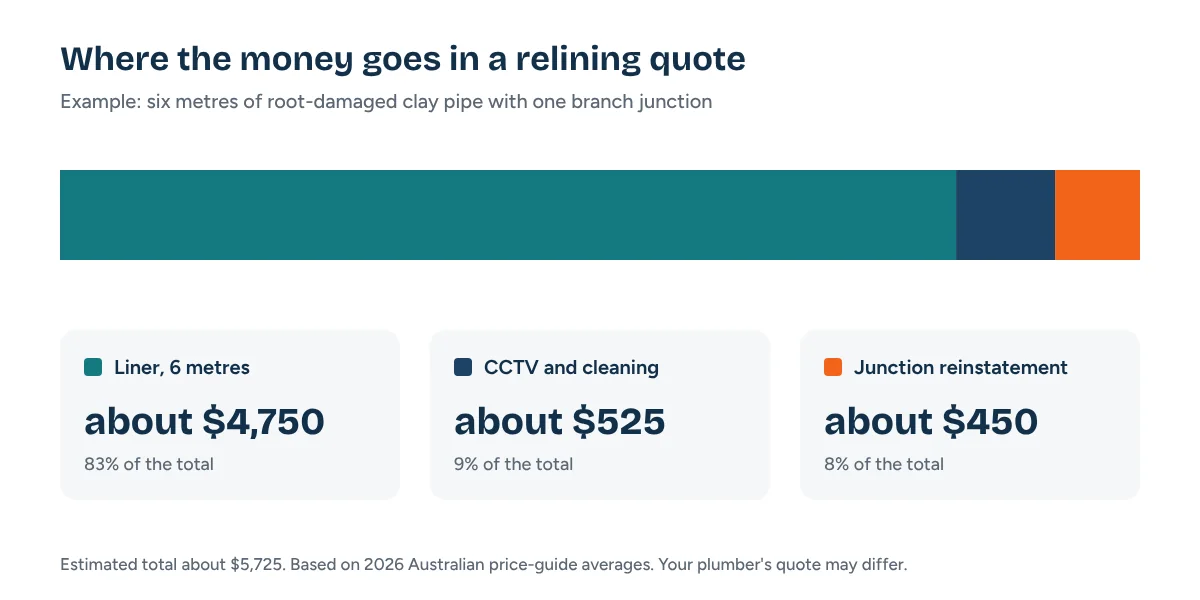
Example 2: six metres of root-damaged clay pipe
A house built in the late 1970s has roots at four joints along a six-metre stretch that runs under the driveway. Patching every joint would cost nearly as much as one continuous liner, so a full reline of that section makes more sense.
- Relining six metres: $2,000 + (5 × $550) = about $4,750
- One junction reinstatement: about $300 to $600
- CCTV and cleaning, if not included: about $350 to $700
- Estimated total: about $5,050 to $6,050
Example 3: a long run with several branches
A larger home has a fifteen-metre sewer line from the back bathroom to the boundary, with three branch pipes joining it. The pipe is cracked in several places and passes under a concrete patio.
- Relining fifteen metres: $2,000 + (14 × $550) = about $9,700
- Three junction reinstatements: about $900 to $1,800
- CCTV and cleaning, if not included: about $350 to $700
- Estimated total: about $10,950 to $12,200
The second guide we used puts a simple eight to twelve metre job at $4,000 to $6,000, and a fifteen to twenty-five metre job at $6,000 to $10,000. That’s lower than the averages above. The difference shows how much prices move between companies, which is exactly why getting two quotes is worth the effort on a job this size.
What pushes a relining cost up or down
Two pipes of the same length can have very different prices. These are the things that move the number.
Access. If there’s a clean inspection opening at each end, the job is straightforward. If the plumber has to cut in an access point through tiles or concrete, that adds labour and a repair bill.
Pipe diameter. Most house sewer lines are 100 mm. Larger stormwater or commercial pipes need more resin and a bigger liner, which costs more per metre.
Number of junctions. Every branch that joins the main line has to be cut open again from the inside after the liner cures. That’s the junction reinstatement line on your quote.
How bad the damage is. Heavy roots take longer to cut out. A pipe with a missing section may need a dig-up repair first, because a liner needs something to sit against.
Bends. Tight bends and changes of direction make the liner harder to install and can need a different product.
After-hours work. If the pipe is blocked and sewage is backing up, an emergency visit to clear it will cost more than a booked weekday job. The relining itself can usually wait until a normal working day once the line is flowing.
Pipe relining cost vs digging up the pipe
This is where a lot of articles stop being honest. The pipe work in a dig-up repair can be cheaper per metre than relining. Simple pipe replacement in an open trench is often priced at $200 to $400 per metre.
The difference is everything around the pipe. If your sewer line runs under:
- a concrete driveway,
- a tiled bathroom or laundry,
- a pool surround or paved entertaining area,
- established trees or a neighbour’s fence,
then digging means breaking it, removing the spoil, replacing the pipe, and rebuilding what was on top. Concrete reinstatement alone is commonly priced at $100 to $200 per square metre, and a tiled floor or landscaped garden can cost far more than that.
So the fair rule is this. If the pipe is shallow and under lawn with easy access, ask for a dig-up price too. It may be cheaper. If the pipe is under anything hard, expensive or alive, relining usually wins, because the total job is smaller and the property is back to normal the same day.
Who pays: owner, landlord or council?
On the Gold Coast, the City of Gold Coast is responsible for the sewer from the main to the property connection point. If the connection point can’t be found, that boundary is one metre inside your property line. Everything on your side of that point is yours.
If the camera shows the problem is in the council’s section, your plumber can report it on 1300 000 928 on the same day. The City may then reimburse reasonable costs, usually capped at $300 including GST, directly to you. There are exclusions, such as blockages caused by wet wipes, so check the City of Gold Coast sewer blockages page before you assume.
If you rent, a blocked toilet or sewer is an emergency repair and your landlord or agent should arrange the plumber. Relining is the owner’s decision because it’s a repair to the property.
As for insurance, many home policies exclude damage that builds up slowly, including tree roots and old pipes wearing out. Sudden damage may be different. Read your policy wording before you rely on a claim.
Pipe relining cost for units, townhouses and stormwater
Not every job is a single house sewer. Two other situations come up often on the Gold Coast.
Units and townhouses. In a strata scheme, the pipe relining cost may not be yours alone. As a general rule, pipes that serve more than one lot are often common property, looked after by the body corporate, while a pipe that serves only your lot may be your responsibility. Every scheme is different, so check the by-laws and the scheme’s plans with your body corporate manager before you book anything. Strata jobs also tend to involve longer runs, more junctions and vertical stacks, so the price per metre can be higher.
Stormwater pipes. Stormwater lines are often larger than sewer pipes and run further, from downpipes and yard pits out to the kerb or a council drain. A bigger diameter means more resin and a bigger liner, so expect a higher relining cost per metre than for a standard 100 mm sewer. On the other hand, stormwater pipes are often shallow, so digging can be a more realistic alternative.
If you’re not sure which pipe is causing the problem, a camera inspection will tell you whether you’re dealing with sewer or stormwater, and who is responsible for it.
How to get a fair quote
You don’t need to know plumbing to spot a good quote. You just need to ask the right questions.
- Ask to see the CCTV footage. A good plumber is happy to show you the cracks and roots. If they won’t show you, get another opinion.
- Ask what’s included. Inspection, cleaning, liner, junctions, the final camera check and clean-up should all be listed.
- Ask about the product. Pipe lining products used in Australia should carry WaterMark certification and be installed to the plumbing standard AS/NZS 3500.
- Ask about the warranty. Liner warranties vary a lot between companies. Get it in writing and check who stands behind it.
- Check the licence. Drainage work in Queensland must be done by a licensed plumber or drainer. You can check a licence on the QBCC website.
- Get a fixed price. Once the camera work is done, there’s no reason the relining price should change on the day unless something new turns up.
Ways to keep the cost down
A few things genuinely save money without cutting corners.
Find out early. A pipe with one root intrusion can often be fixed with a single patch. Leave it for a few years and the roots spread to the next joints, and you’re paying for a full liner.
Combine jobs. If the plumber is already on site with a camera and a jetter, adding a nearby stormwater pipe or a second patch is cheaper than calling them back.
Don’t pay to clear the same blockage over and over. If you’re booking a jetter every six to twelve months for the same root problem, add up what you’ve spent. Three or four clears can cost as much as fixing the pipe for good. Our guide on whether pipe relining is worth it runs through that maths in more detail.
Ask for a dig-up price when it’s genuinely an option. As covered above, a shallow pipe in open lawn can be cheaper to replace.
Is the relining cost worth it?
For most homes with a cracked or root-damaged sewer under concrete or near trees, yes. You avoid the mess, the yard is back to normal the same day, and you stop paying for repeat blockages. For a pipe in open lawn, it’s worth comparing both options.
If you’re not sure what’s actually wrong with your pipe yet, start with a camera inspection. It’s the cheapest way to turn a vague “it keeps blocking” into a clear fix and a firm price. If you’d like to understand how the liner actually works before you decide, read our plain-English guide on what pipe relining is.
Frequently asked questions
How much does pipe relining cost per metre?
Australian price guides put pipe relining at around $2,000 for the first metre, which covers setup, then about $400 to $800 for each extra metre. Oneflare's average is $550 per additional metre.
Is pipe relining cheaper than digging up the pipe?
Often, but not always. If the pipe is shallow and runs under open lawn, digging can cost less. Once the pipe is under concrete, tiles, a pool or tree roots, relining usually works out cheaper because nothing needs to be rebuilt afterwards.
Does home insurance pay for pipe relining?
Sometimes. Many policies exclude gradual wear and tree-root damage, while sudden damage may be covered. Read your product disclosure statement and ask your insurer before you book the work.
Why do two relining quotes for the same pipe differ so much?
Quotes differ when one includes the CCTV inspection, cleaning, junction reinstatement and the follow-up camera check, and the other doesn't. Ask each plumber to list exactly what's included so you're comparing the same job.
Can the council pay for part of my drain repair?
Only if the problem is in the council's part of the sewer. On the Gold Coast, the City may reimburse a plumber up to $300 including GST for a blockage caused by its sewer, if the plumber reports it on the same day.
About this guide
Written by the Gold Coast Drain & Pipe team and last checked on 29 October 2026. Prices come from current Australian price guides and include GST. Your plumber confirms a firm price before starting any work.
Gold Coast Drain & Pipe is a referral service. We connect you with one licensed, independent Gold Coast plumber and don't carry out plumbing work ourselves. How our service works.
Sources