Key takeaways
- Pipe relining builds a new, seamless pipe inside your old one using a resin-soaked liner, so there's no trench to dig.
- A typical house job takes one day and follows seven steps, from camera inspection to a final camera check.
- It suits cracked pipes, leaking joints and root damage in clay, cast iron, PVC and concrete pipes.
- It won't fix a fully collapsed pipe or a pipe that sags and holds water. Those need digging.
- In Australia, lining products should carry WaterMark certification and be installed to AS/NZS 3500.
On this page
- What is pipe relining, in plain English?
- Why pipes need fixing in the first place
- Signs your pipe could be a relining candidate
- How pipe relining works: the 7 steps
- The different types of relining
- Which pipes can be relined?
- When relining won’t work
- Pipe relining vs other repair methods
- Rules and standards in Queensland
- What to expect on the day
- How long does relining last?
- The short version
What is pipe relining? It’s a way to fix a broken pipe from the inside, without digging a trench. A flexible tube soaked in resin is pushed into the old pipe, pressed against its walls and left to harden. A few hours later you have a smooth, joint-free pipe sitting inside the old one.
If a plumber has just mentioned relining and you nodded along without being sure what it means, this guide is for you. We’ll go through how pipe relining works, step by step, which pipes it suits, and the situations where it’s the wrong fix.
What is pipe relining, in plain English?
Think of it as a pipe inside a pipe. Your old sewer or stormwater pipe stays in the ground, and it becomes the mould for a new one.
The new pipe starts life as a soft tube made of felt or fibreglass. On site, the crew soaks it in a liquid resin, usually an epoxy. They feed the tube into your pipe, then inflate it so it presses firmly against the old walls. The resin hardens, either on its own or with heat, steam or UV light, and the soft tube turns into a rigid pipe.
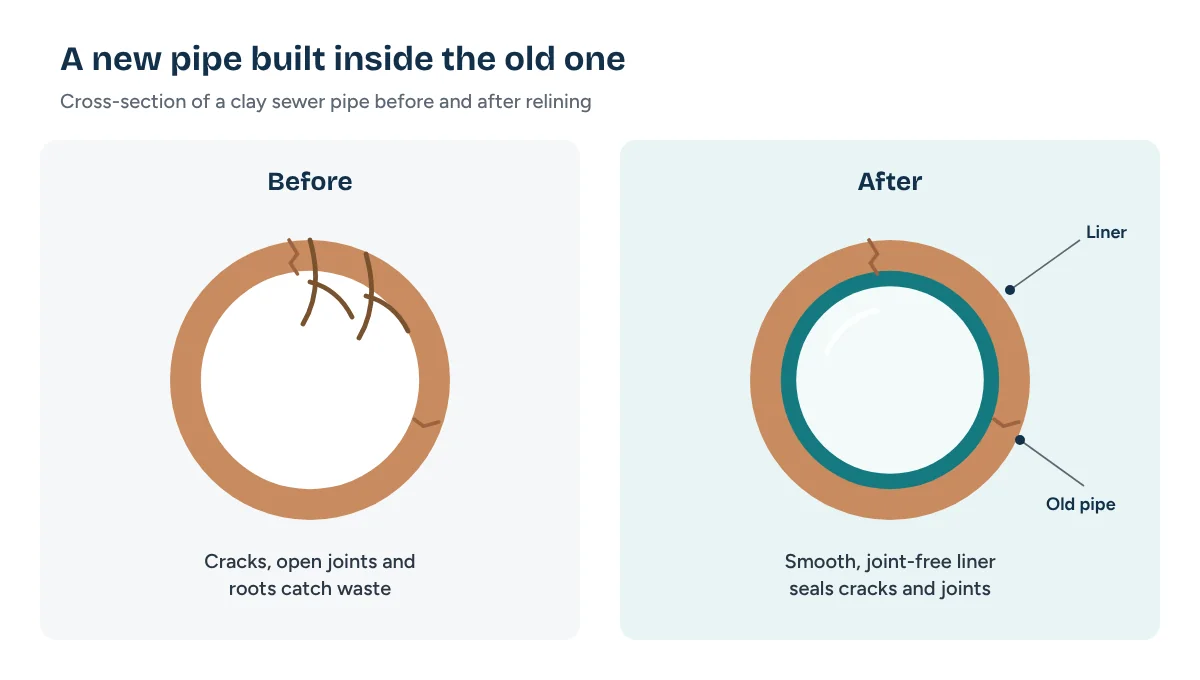
Because the liner is one continuous piece, it covers the cracks and the joints where roots usually get in. That’s the main reason pipe relining works so well on older clay sewer lines, which are made of short lengths with a joint every metre or so.
You’ll also hear it called cured-in-place pipe (CIPP), no-dig pipe repair or trenchless pipe repair. They all describe the same idea.
Why pipes need fixing in the first place
Most of the pipes that end up relined on the Gold Coast have one of these problems.
Tree roots. Roots find the moisture at pipe joints and push in through tiny gaps. Once inside, they grow into a net that catches toilet paper and waste. Clearing them gives you a few months of relief, then they grow back.
Cracks. Older clay and earthenware pipes are brittle. Ground movement, heavy vehicles and tree roots outside the pipe can crack them.
Displaced joints. Over decades, sections of pipe can shift slightly out of line. Waste catches on the lip and blockages start forming at the same spot.
Corrosion. Cast iron pipes rust from the inside, leaving a rough surface that catches waste.
Homes built before the late 1980s are the most likely to have clay sewer pipes. Many newer estates in the northern Gold Coast use PVC, which has fewer joints and lasts better, though it can still be damaged by roots or ground movement.
Signs your pipe could be a relining candidate
You can’t see inside a sewer pipe, but it usually tells you when something’s wrong. These are the signs that often lead to a relining job.
- The same drain blocks again and again. If a plumber clears it and it’s back within months, roots or a broken joint are the usual cause.
- Gurgling from the toilet or floor waste when other fixtures drain.
- A sewage smell outside, often near the overflow relief gully or along the line of the pipe.
- Soggy or unusually green patches of lawn above where the sewer runs, even in dry weather.
- Water coming up through the outdoor gully after heavy use, like when the washing machine empties.
- Trees or large shrubs close to the sewer line, especially fig trees, palms and other species with aggressive roots.
None of these prove the pipe needs relining. They prove it’s worth a camera inspection, which is the only way to know.
How pipe relining works: the 7 steps
Every company has its own system, but a good relining job follows the same basic sequence.
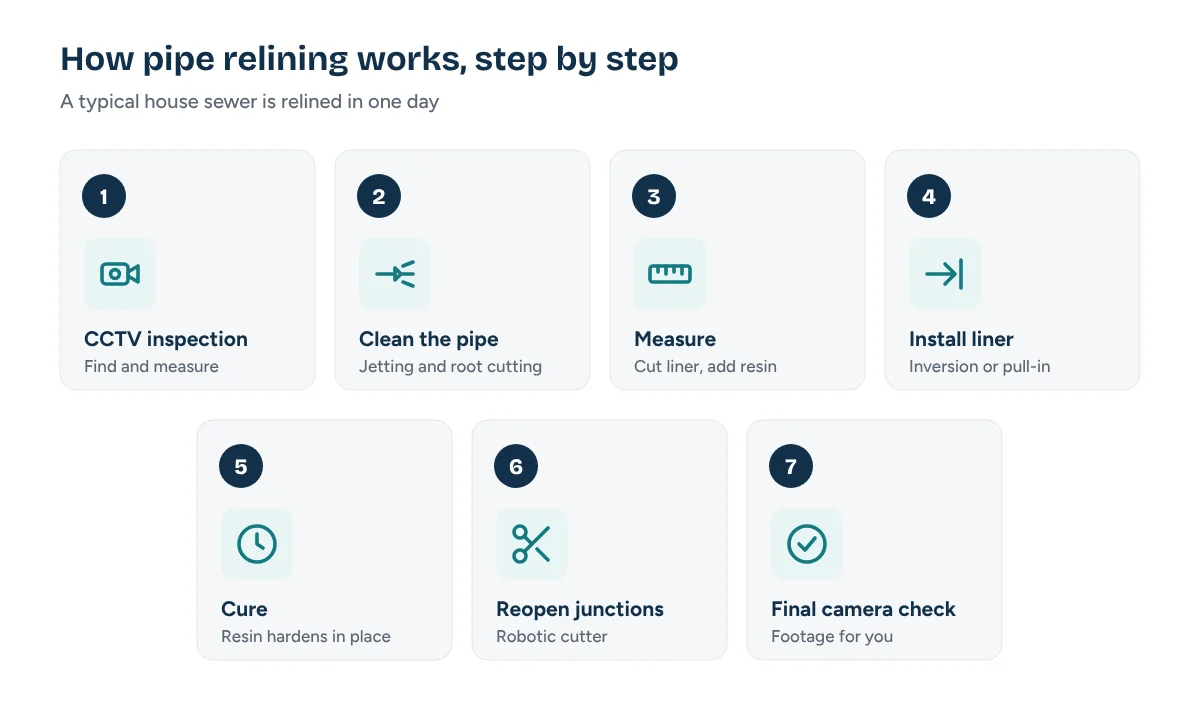
1. CCTV camera inspection
A small waterproof camera on a flexible rod goes into the pipe through an inspection opening. The plumber records the whole run and notes every crack, root intrusion, junction and bend. This footage decides whether relining is possible and how long the liner needs to be.
2. Cleaning the pipe
The liner needs a clean wall to bond to. The pipe is cleared with a high-pressure water jetter, and tree roots are cut out with a rotating cutter. Heavy root growth can take a while. Scale and rust are removed from cast iron.
3. Measuring and preparing the liner
The plumber measures the diameter and the exact length to be relined. The liner is cut to size and soaked in resin on site. This step is called “wetting out”, and the resin is mixed just before use because it starts to harden once mixed.
4. Installing the liner
The soaked liner goes into the pipe in one of two ways. With inversion, air or water pressure turns the liner inside out as it travels along the pipe, so the resin side ends up against the old wall. With pull-in, the liner is winched into place and then inflated with a bladder.
5. Curing
The liner is held under pressure while the resin hardens. Some resins cure at normal temperature in a few hours. Others are sped up with hot water, steam or UV light. Once cured, the bladder is removed and you’re left with a rigid new pipe.
6. Reopening the junctions
Where branch pipes join the main line, the liner has covered the opening. A robotic cutter goes in and cuts each junction open again from the inside. Some jobs then add a short “top hat” or junction liner to seal the connection.
7. Final camera check
The camera goes through one last time so you can see the finished pipe. Ask for a copy of this footage. It’s your proof the job was done and useful if you ever sell the house.
The different types of relining
You’ll see a few names on quotes. Here’s what they mean.
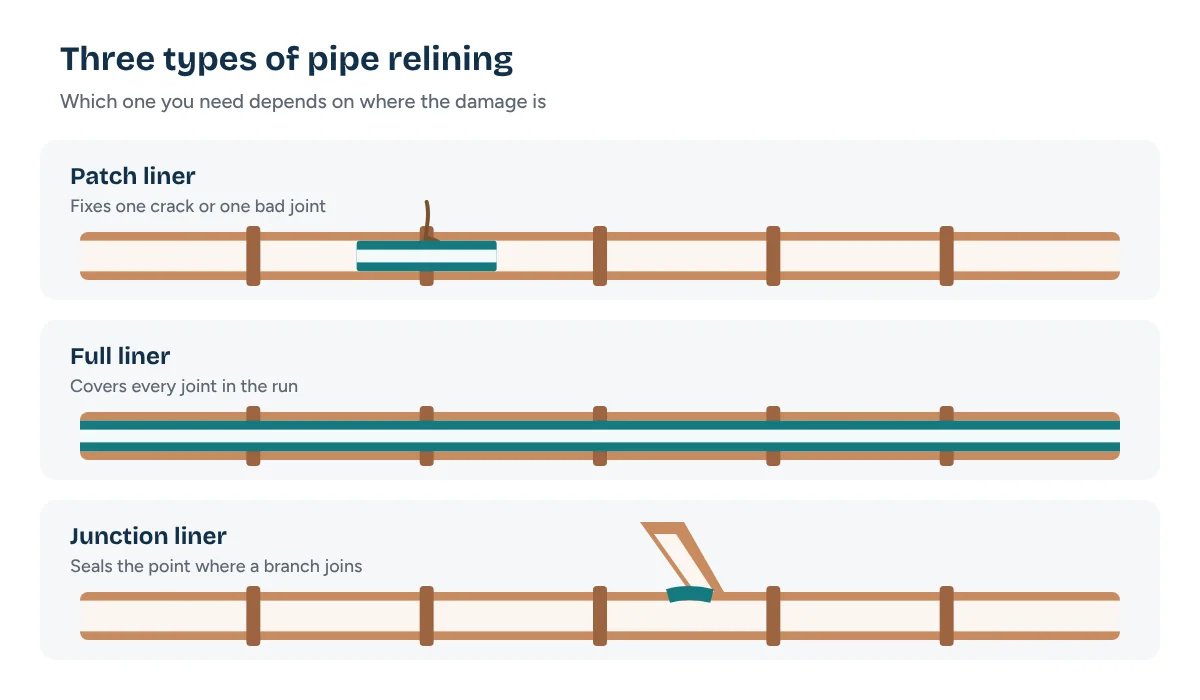
Full relining. One continuous liner from one access point to the next. It’s used when the damage is spread along the pipe, which is common with clay pipes.
Patch relining. A short liner, often under a metre, placed over one crack or one bad joint. It’s cheaper and quicker when the rest of the pipe is sound.
Junction relining. A shaped liner that seals the point where two pipes meet. Junctions are a common weak spot for roots.
Pipe coating. A thin epoxy coating brushed or sprayed onto the inside of smaller pipes. It’s used more for pressure water pipes and narrow waste pipes than for sewer lines.
If you’re comparing prices between these options, our pipe relining cost guide has worked examples for each.
Which pipes can be relined?
Relining works on most common pipe materials found in Australian homes:
- clay and earthenware sewer pipes,
- cast iron,
- PVC,
- concrete and fibre cement stormwater pipes.
It suits pipes from narrow internal waste lines up to large stormwater and commercial drains, although bigger pipes need bigger equipment and cost more. It can go around gentle bends, and a good crew can handle most of the 45-degree bends found in house drainage.
When relining won’t work
Relining is clever, but it isn’t magic. A plumber who tells you it fixes everything isn’t being straight with you. These problems usually need a dig-up repair instead, or at least a dig-up for part of the pipe.
A collapsed pipe. The liner needs an existing pipe to hold its shape while it cures. If a section has caved in completely, there’s nothing for it to sit against.
A sagging or “bellied” pipe. If part of the pipe has sunk and holds water, a liner follows the same sag. The water and waste will still pool there.
A badly offset joint. Small shifts are fine. A joint that has moved so far that the camera can barely get past may need to be dug up and realigned.
A pipe that has already been relined. Each liner reduces the inside diameter slightly. Relining the same section twice is generally not recommended.
The good news is that one bad section doesn’t rule out relining for the rest. It’s common to dig up and replace a short collapsed piece, then reline the rest of the run.
Pipe relining vs other repair methods
Relining isn’t the only way to fix a broken pipe. Here’s how it compares with the alternatives a plumber might mention.
Dig and replace. The traditional method. A trench is dug, the old pipe is removed and new PVC goes in. You end up with a brand new pipe, but you also end up rebuilding whatever was on top. It’s often the right choice for a short, shallow pipe under lawn, or for a section that has collapsed.
Pipe bursting. Another no-dig method. A bursting head is pulled through the old pipe, cracking it outwards while dragging a new plastic pipe in behind it. It needs access pits at each end and is more common for larger or longer runs than for typical house drains.
Repeat jetting. Not a repair at all, but a common choice. A high-pressure jetter cuts out the roots and the pipe flows again. It’s cheaper on the day, but the roots grow back because the gaps they came through are still there.
Root-killing treatments. Some products are sold to slow root growth in pipes. They may buy some time, but they don’t fix the crack or joint the roots are using, and the roots usually return.
Relining sits between a quick clear and a full dig. It costs more than one clear, but it deals with the cause. It costs less disruption than digging, and often less money once you count what has to be rebuilt.
Rules and standards in Queensland
Pipe relining is drainage work, and in Queensland that must be done by a licensed plumber or drainer. You can check what counts as regulated plumbing work on the QBCC website.
Since late 2018, pipe lining products used in Australia need WaterMark certification and must be installed to the national plumbing standard, AS/NZS 3500. The WaterMark specification for cured-in-place pipe sets requirements for wall thickness, strength and chemical resistance. In practice, this means you should be able to ask your plumber which product they use and get a clear answer.
On the Gold Coast, your side of the sewer ends at the property connection point. If the camera shows the damage is beyond that point, it belongs to the City. The City of Gold Coast sewer blockages page explains who looks after which part.
What to expect on the day
A typical house job looks something like this:
- Morning: the crew arrives, runs the camera and starts cleaning the pipe.
- Midday: the liner is wet out and installed.
- Afternoon: the liner cures, junctions are reopened and the final camera check is done.
You’ll be asked not to run water into that pipe while the liner is going in and curing, which usually means no toilets, showers or washing machine for a few hours. Some resins have a smell while they cure, so it’s worth asking about ventilation if anyone at home is sensitive to fumes.
There’s no trench, no skip bin and usually no mess beyond the area around the inspection opening.
A little preparation helps the day run smoothly:
- Clear access to the inspection openings. Move pot plants, bins or outdoor furniture away from the capped pipes in your yard.
- Do the washing the day before. You won’t want the machine emptying into the pipe while the liner cures.
- Tell the crew about pets and young children, since there’ll be hoses, equipment and an open pipe outside.
- Ask for the before and after footage to be sent to you, so you have a record of the job.
How long does relining last?
Liner warranties in Australia commonly run from 25 to 50 years, and manufacturers design their products to last for decades. Real-world life depends on the product, how well the pipe was cleaned before lining and what goes down the drain afterwards. Roots can’t get through a properly installed liner because there are no joints for them to find.
If you’re weighing up whether it’s worth the money compared with digging or simply clearing the blockage again, read our guide on whether pipe relining is worth it.
The short version
So, what is pipe relining? It’s a no-dig repair that builds a new pipe inside your old one. It’s best for cracked, leaking or root-damaged pipes that are still holding their shape, especially under driveways, slabs, pools and trees. It isn’t the answer for a collapsed or badly sagging pipe.
The first step is always the same: get a camera down the pipe and see what you’re dealing with.
Frequently asked questions
What is pipe relining in simple terms?
Pipe relining is a way to fix a damaged pipe from the inside. A flexible tube soaked in resin is pushed into the old pipe, pressed against its walls and left to harden. The result is a new, joint-free pipe inside the old one, with no trench.
How long does pipe relining take?
Most house sewer relining jobs are finished in one day. A single patch can take a few hours. Longer runs with several branch pipes can take a second day.
Can I use my toilet and shower during relining?
Not while the liner is being installed and cured, because water can't run through that pipe. Most crews ask you to avoid running water for a few hours. They'll tell you when it's safe again.
Does relining make the pipe smaller?
Slightly. The liner is only a few millimetres thick, so a 100 mm sewer pipe loses a little width. Because the new surface is smooth and has no joints, it usually flows just as well or better.
How long does a relined pipe last?
Liner warranties in Australia commonly run from 25 to 50 years, and manufacturers design their products for decades of service. Ask your plumber for the written warranty and the product name.
About this guide
Written by the Gold Coast Drain & Pipe team and last checked on 29 October 2026. Prices come from current Australian price guides and include GST. Your plumber confirms a firm price before starting any work.
Gold Coast Drain & Pipe is a referral service. We connect you with one licensed, independent Gold Coast plumber and don't carry out plumbing work ourselves. How our service works.
Sources